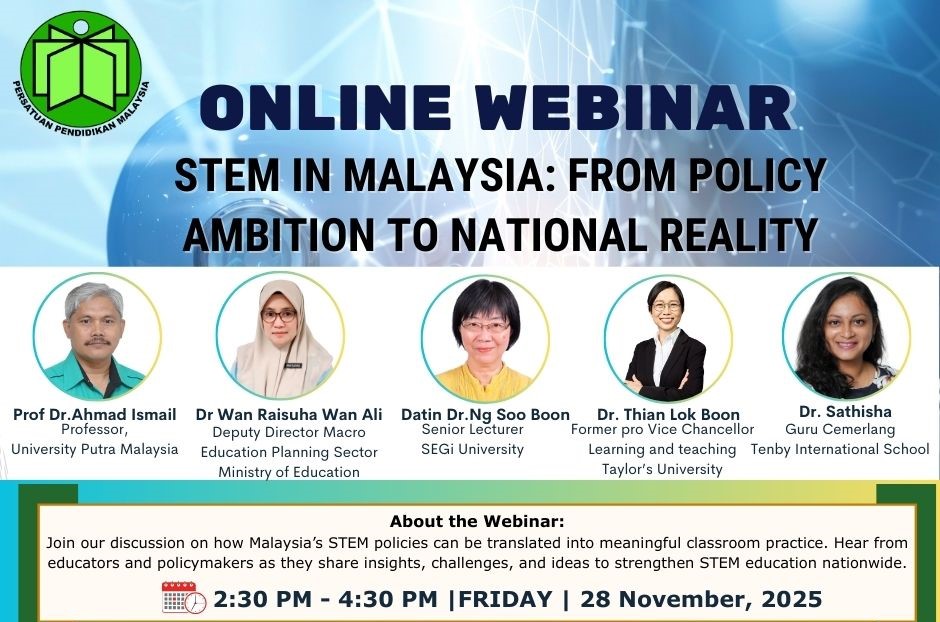
I had the privilege of speaking at the STEM in Malaysia – From Policy Ambition to National Reality national webinar organised by the Malaysian Association for Education (MAE), where I shared a story about my young son.
He loves cycling in our neighbourhood park. But the entrance was often blocked by cars and motorbikes. One day, he asked, “Why does no one fix this?”
So, we took photos, explored solutions, and sent a proposal to the local council together. Not a school project — just something he cared about.
That moment reminded me of the question at the heart of STEM education today:
Are our children still curious about the world around them?
Because the reality is worrying:
– 92% of Malaysian teens are on social media (UNICEF)
– 73.7% show signs of social media addiction (a study in Selangor)
– 35% are addicted to online games (a study in Selangor)
– 1 in 4 felt depressed, 1 in 10 had attempted suicide (The NHMS 2022 Adolescent Health Survey)
A generation that is hyper-connected, but not necessarily deeply engaged — or well.
In my session, I shared four ways to reconnect Gen Alpha with STEM through meaning and care:
1. Let them do science, not just study it
2. Ground learning in real problems they can see
3. Connect lessons to their communities and environment
4. Put empathy before innovation
Because when learning is meaningful, collaborative, and human, our children are more willing to persist, take risks, and care.
And that’s when young Malaysians will look at the challenges faced by their school, their town, their kampung — and say:
“This is my problem too. And I want to solve it.”
Are our children still curious about the world around them?
 By
/ December 6, 2025
By
/ December 6, 2025